Critical Thinking Program
Teach your students to question everything.
Because in a crowd of students, critical thinkers will stand out in the future.
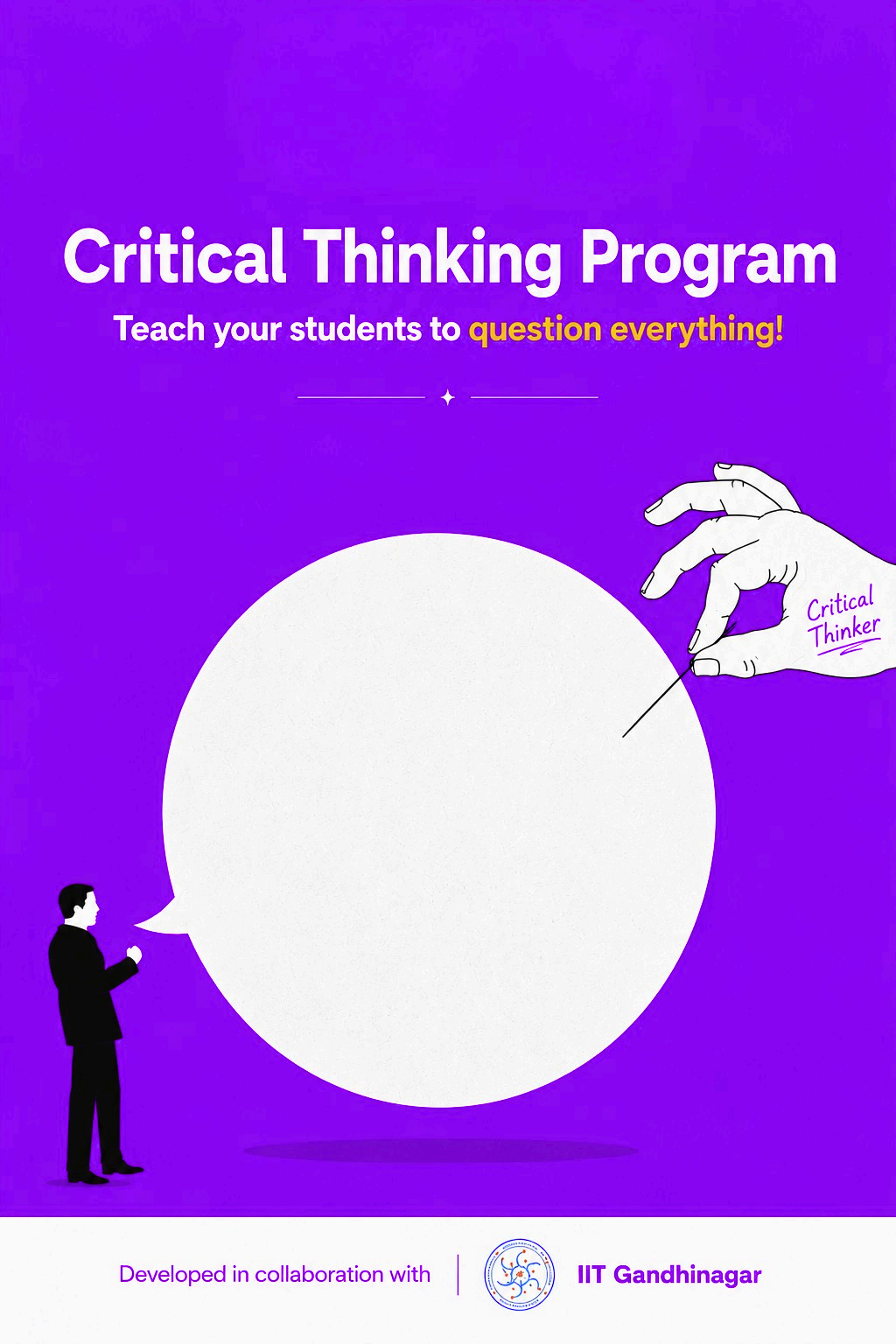
Schools teach subjects. Who teaches students how to think?
Every day, students encounter information, opinions, and increasingly complex questions. Yet many classrooms still reward finding the right answer more than asking the right question.
Preparing students for the future isn't only about teaching more content. It's about helping them become thoughtful learners who can question assumptions, evaluate evidence, and make reasoned decisions.
That's where the Critical Thinking Program fits naturally into the school day — giving teachers structured tools to develop thinking, not as an extra activity, but as an essential part of learning.
Currently designed for students of Classes 3–8, conducted for one period each week as part of the regular school timetable. Sessions are facilitated by the school's own class teacher, making implementation simple and sustainable. Classes 3–4 will be introduced from the 2027–2028 academic session onwards.
Schools leading the shift towards critical thinking.
Schools across India are building classrooms where questioning, discussion, and reasoning become part of everyday learning.
Every discussion begins with thinking.
Students don't begin with answers. They begin with questions.
The teacher becomes a facilitator of thinking — guiding students to question, listen, reason, and communicate rather than simply memorise information.
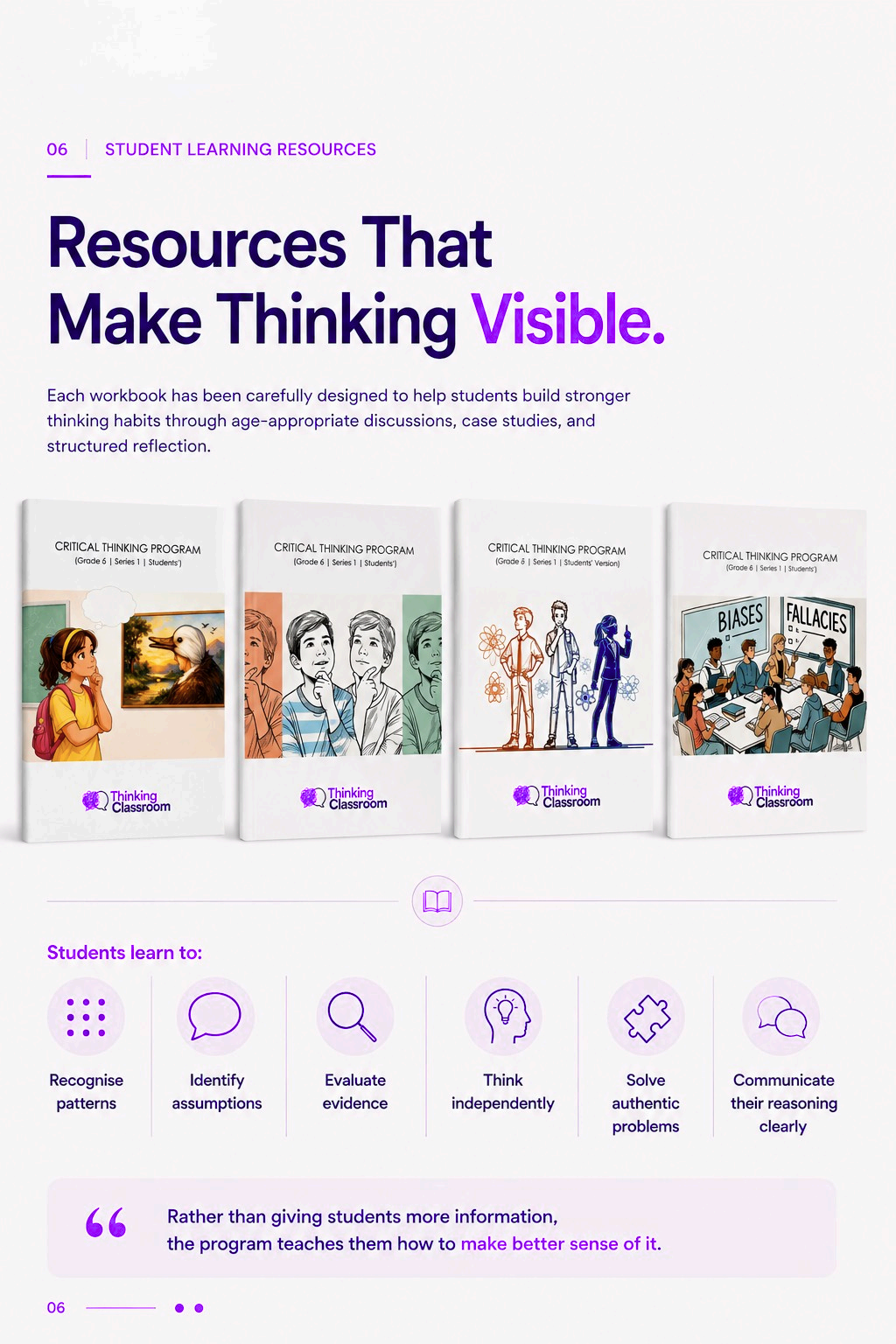
Resources that make thinking visible.
Each workbook is carefully designed to help students build stronger thinking habits through age-appropriate discussions, case studies, and structured reflection.
- ✓ Recognise patterns
- ✓ Identify assumptions
- ✓ Evaluate evidence
- ✓ Think independently
- ✓ Solve authentic problems
- ✓ Communicate their reasoning clearly
Rather than giving students more information, the program teaches them how to make better sense of it.
Case studies from our Critical Thinking Workbooks
Every week, students explore carefully designed questions that encourage curiosity, discussion, reasoning, and evidence-based thinking.

Who's the Better Batsman?
How do we compare performance fairly?

Who Should Get the Last Slice of Pizza?
Fairness isn't always as simple as it seems.

Which Dentist Would You Choose?
What evidence should guide our decisions?

How Do We Decide What's Real?
How do we tell whether news is real or fake?

Are Zoos Cruel to Animals?
Can two opposing viewpoints both have valid arguments?

Should We Give Money to Beggars?
What factors should we consider before we decide?

Why Does a Black Hole Appear Black?
Curiosity begins with asking "why."

Are Bats Really Blind?
Question assumptions before accepting information.
What we provide to build a Critical Thinking Classroom
The Program in Action
From teacher training sessions to student-led discussions — here's what a Thinking Classroom looks like.
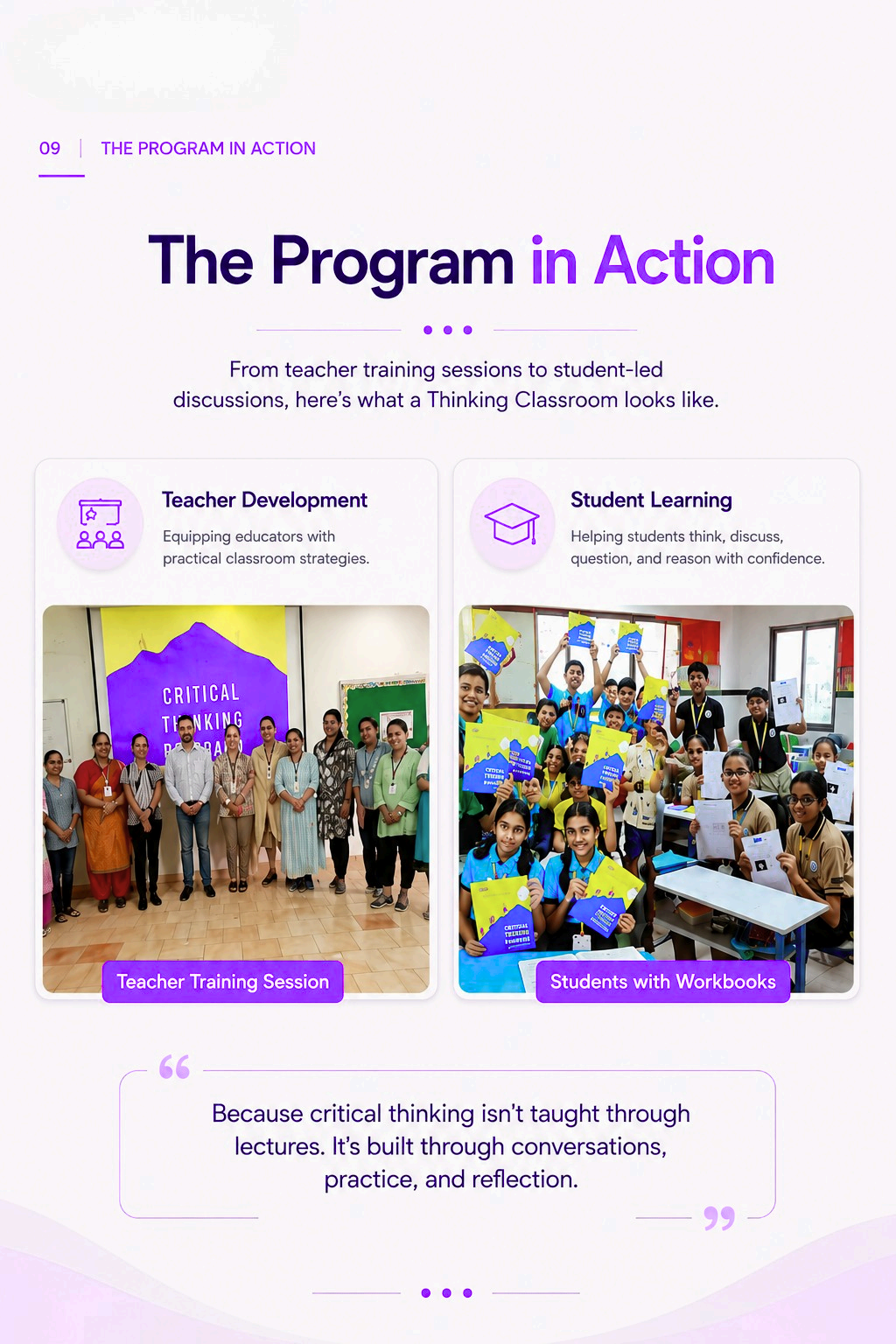
Equipping educators with practical classroom strategies.
Helping students think, discuss, question, and reason with confidence.
Because critical thinking isn't taught through lectures. It's built through conversations, practice, and reflection.
What does the Critical Thinking Program build?
The program goes beyond helping students answer questions. It helps them become curious, confident, and independent learners prepared to think through challenges across subjects and in everyday life.
Independent Learners
Students learn to question, investigate, and construct their own understanding instead of relying solely on memorisation or teacher-led instruction.
Better Learning Across Subjects
The ability to reason, evaluate evidence, and think critically strengthens learning in Mathematics, Science, Social Science, Languages, and beyond.
Meaningful Classroom Discussions
Students become active participants by asking thoughtful questions, considering multiple perspectives, and communicating ideas with confidence.
Measure improvement in critical thinking
Critical Thinking assessments give schools actionable insights into students' thinking skills, helping teachers monitor progress.
A Sustainable Thinking Culture
Because the program is taught by the school's own teachers, critical thinking gradually becomes part of everyday classroom practice.
Everything school leaders usually ask
01Who teaches the Critical Thinking Program?+
The program is delivered by the school's own class teacher after participating in our structured teacher training. This ensures it becomes a natural part of the school's teaching culture rather than depending on external facilitators.
02When is Critical Thinking taught?+
The program is conducted during one dedicated period each week and integrates seamlessly into the existing school timetable without disrupting the academic schedule.
03How does the demo process work?+
We begin with an introductory meeting to understand your school's context, followed by a live demonstration. You'll experience how a Critical Thinking lesson works, explore the workbooks, and discuss implementation with our academic team.
04How much time does implementation take?+
Schools can begin implementation within a few weeks. Once teachers complete the orientation and training, the program can be introduced into the regular timetable with ongoing support from the Thinking Classroom team.
05Which classes is the program currently available for?+
The Critical Thinking Program is available for Classes 3–8.
06Can the program fit into our existing curriculum?+
Yes. The program is designed to integrate seamlessly into the existing timetable and complements the curriculum without adding unnecessary academic burden. It strengthens thinking skills students use across all subjects.
Ready to bring Critical Thinking to your school?
Build classrooms where thinking is encouraged, discussions are meaningful, and students thrive.